Amazon Great Indian Festival 2026 starts 8 October. See the confirmed offers, how discounts really work, and a simple plan to buy only what you need.
By Afraz Alam | Last reviewed: 27 September 2026
FIND N FORM is reader-supported. As an Amazon Associate I earn from qualifying purchases. This guide is based on Amazon’s official announcements, public reporting and consumer research. We have not tested products for this guide, and we don’t recommend any specific product in it.
Your Amazon cart already has something in it. Maybe a few things. The sale hasn’t even started.
And you know how this goes. The countdown starts. The banners get louder. “Lowest price of the year.” “Only a few left.” “Deal ends in 02:14:36.” Suddenly you’re adding a second pair of earbuds, a kitchen gadget you’ve never needed, and a kurta set in a colour you’re not sure about. It’s the Great Indian Festival, after all. If you don’t buy now, when will you?
A week later, the boxes arrive. Some of it you’re happy with. Some of it goes straight into a drawer. And the one thing you actually wanted? Its sale price turns out to be almost the same as it was in August.
This isn’t about willpower. Big sales are designed to make buying feel urgent. The discounts are real on some products, but the pressure is real on all of them.
So here’s the one rule this guide is built on:
Don’t shop the sale. Shop your list.
In this guide, you’ll find:
The confirmed dates and offers for the Amazon Great Indian Festival 2026 (and what’s still unconfirmed)
How each offer really works, including the fine print on bank discounts and No Cost EMI
A 2-minute way to check if a “deal” is actually a deal
The 9 sale traps that make people overspend
What’s worth buying in fashion, beauty, personal care and lifestyle, and what to skip
A simple 7-step plan to follow before the sale opens
Amazon Great Indian Festival 2026 at a glance
Main sale starts
8 October 2026 (confirmed by Amazon)
Prime early access
Expected from 7 October, 24 hours before everyone else
Early deals
Already showing in the Amazon app ahead of the main sale
End date
Not announced yet (last year’s sale ended on 20 October)
Bank offer
10% instant discount on SBI Credit and Debit Cards, including EMI transactions (terms apply)
Prime members
“Up to 10% extra” on eligible deals, as announced by Amazon
Deal types
Blockbuster Deals, Top 100 Deals, Mega Deals, 8 PM Deals, Buy More Save More, Exchange Mela, Amazon Combos, No Cost EMI
Our advice in one line: make a list with a budget for each item before 7 October, check each item’s price history, and buy only what’s on the list.
What is the Amazon Great Indian Festival?
The Amazon Great Indian Festival is Amazon India’s biggest sale of the year. It runs every year in the weeks before Diwali, when many Indian families plan big purchases, gifts and festive shopping.
The sale covers almost every category: smartphones, electronics, appliances, fashion, beauty, home, kitchen and groceries. Amazon says customers can expect “the lowest prices of the year on crores of products.”
Two things are worth knowing before you start:
It’s a marketing event. Amazon runs it to bring in a huge number of orders in a short time. That doesn’t make the discounts fake. It just means everything about the sale, from the timers to the banners, is built to get you to buy more, faster.
It’s not a one-time chance. Amazon runs several big sales across the year, such as the Great Summer Sale, Prime Day and the Great Freedom Sale, plus smaller brand and bank offers in between. If you miss a deal this October, a similar one may well come back within a few months.
Flipkart’s Big Billion Days usually runs at around the same time, so you can compare prices across both.
Amazon Great Indian Festival 2026 dates and timeline
Here’s what we know so far.
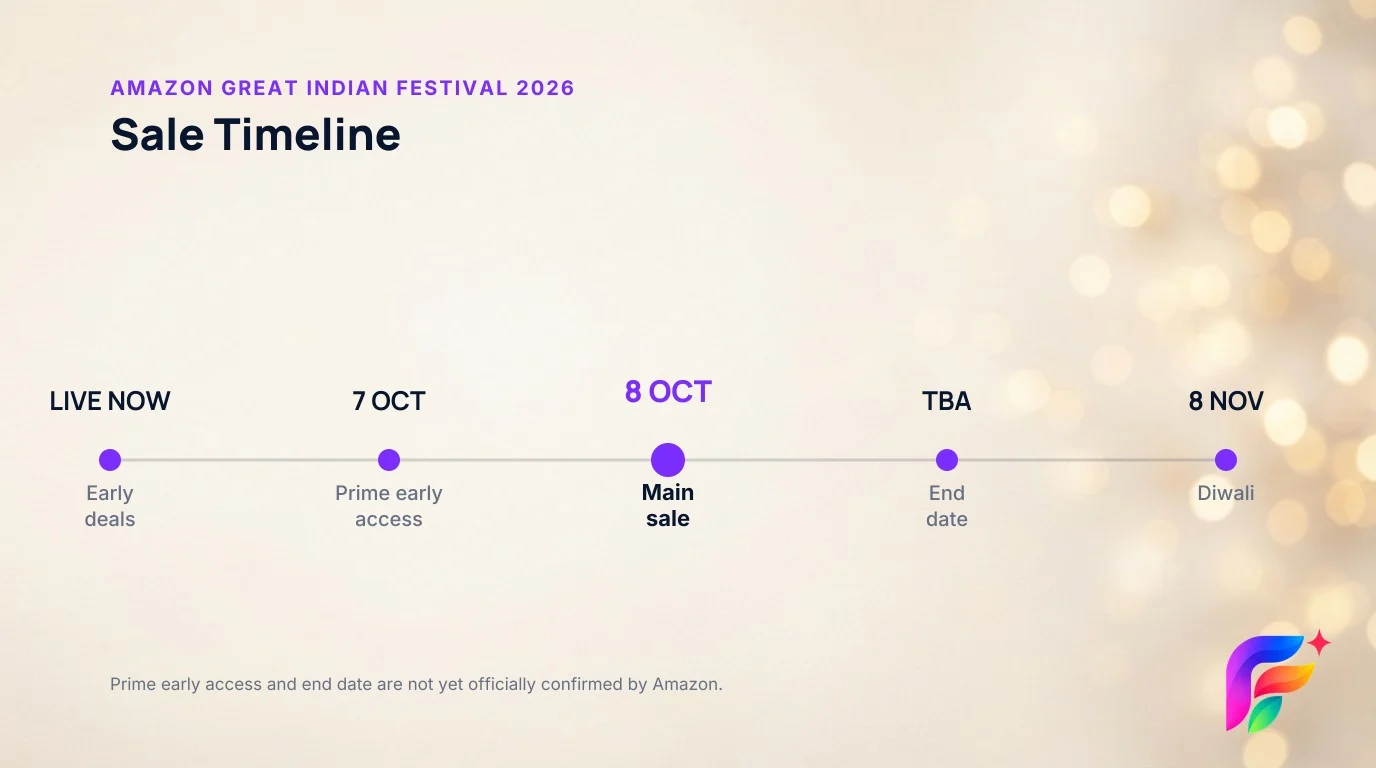
Early deals: live now. Amazon has started showing early festival deals in the app before the main sale opens. These are a good time to check prices, not a reason to rush.
Prime early access: 7 October (expected). Prime members usually get 24 hours of early access before the sale opens to everyone. Reports point to 7 October for this year. Amazon has confirmed early access for Prime members but hasn’t published the exact start time yet.
Main sale: 8 October 2026 (confirmed). This is the official start date announced by Amazon.
End date: not announced. Amazon hasn’t said when the 2026 sale will end. Last year, the festival ended on 20 October 2025. We’ll update this page as soon as Amazon confirms the date.
Diwali: 8 November 2026. The sale sits about a month before Diwali, so it’s a natural time to plan gifts and festive shopping.
Early deals are already live. Prime early access is expected 7 October. The main sale is confirmed for 8 October.
A quick lesson on “leaked” dates: in mid-September, Amazon’s own AI shopping assistant suggested the sale might start around 27 September. The real date turned out to be 8 October. Predictions, leaks and rumours about deals are often wrong. Trust official announcements and what you can see in the app.
Every Amazon Great Indian Festival offer, explained in plain English
Sale pages are full of offers, and they don’t all work the same way. Here’s what each one actually means for the final price you pay.
SBI bank offer: 10% instant discount
Amazon has confirmed a 10% instant discount on SBI Credit and Debit Cards, including EMI transactions.
The words to watch are “up to” and “minimum.” Bank offers almost always come with:
A maximum discount (cap). 10% off doesn’t mean 10% off any amount.
A minimum order value. Small orders may not qualify at all.
Limits per card. There’s often a limit on how many times one card can use the offer during the sale.
Different rules for EMI and full payment. The cap is sometimes different for EMI transactions.
Example
Example (illustrative numbers, not the actual SBI terms): say the offer is “10% instant discount, up to ₹1,000, on orders above ₹5,000.”
You buy something for ₹12,000. 10% would be ₹1,200, but the cap is ₹1,000. You save ₹1,000.
You buy something for ₹4,500. It’s below the minimum. You save nothing.
Always open the offer’s terms and conditions on the product page to see the real cap and minimum before you plan around it.
If you don’t have an SBI card, don’t apply for a new credit card just for a sale discount. Annual fees and the temptation to overspend can easily cost more than one festive discount saves.
Prime member extra: “up to 10% extra”
Amazon says Prime members get “up to 10% extra” during the sale. The key word is “up to.” It applies to eligible deals, and the extra saving will vary from product to product. Don’t assume every item gets 10% more off.
If you’re not a Prime member, work out whether the extra savings on the things on your list are more than the membership cost. For most people buying one or two items, they won’t be.
No Cost EMI: is it really free?
No Cost EMI lets you split a purchase into monthly payments without paying interest. Here’s how it actually works.
Your bank still charges interest on the EMI. The seller or brand gives you an upfront discount equal to that interest, so the two cancel out. That part is fair. But two costs usually remain:
GST on the interest. The bank charges 18% GST on the interest part of your EMI. The discount doesn’t cover this.
A processing fee. Many banks charge a one-time processing fee for converting a purchase into EMI, plus GST on that fee.
Example
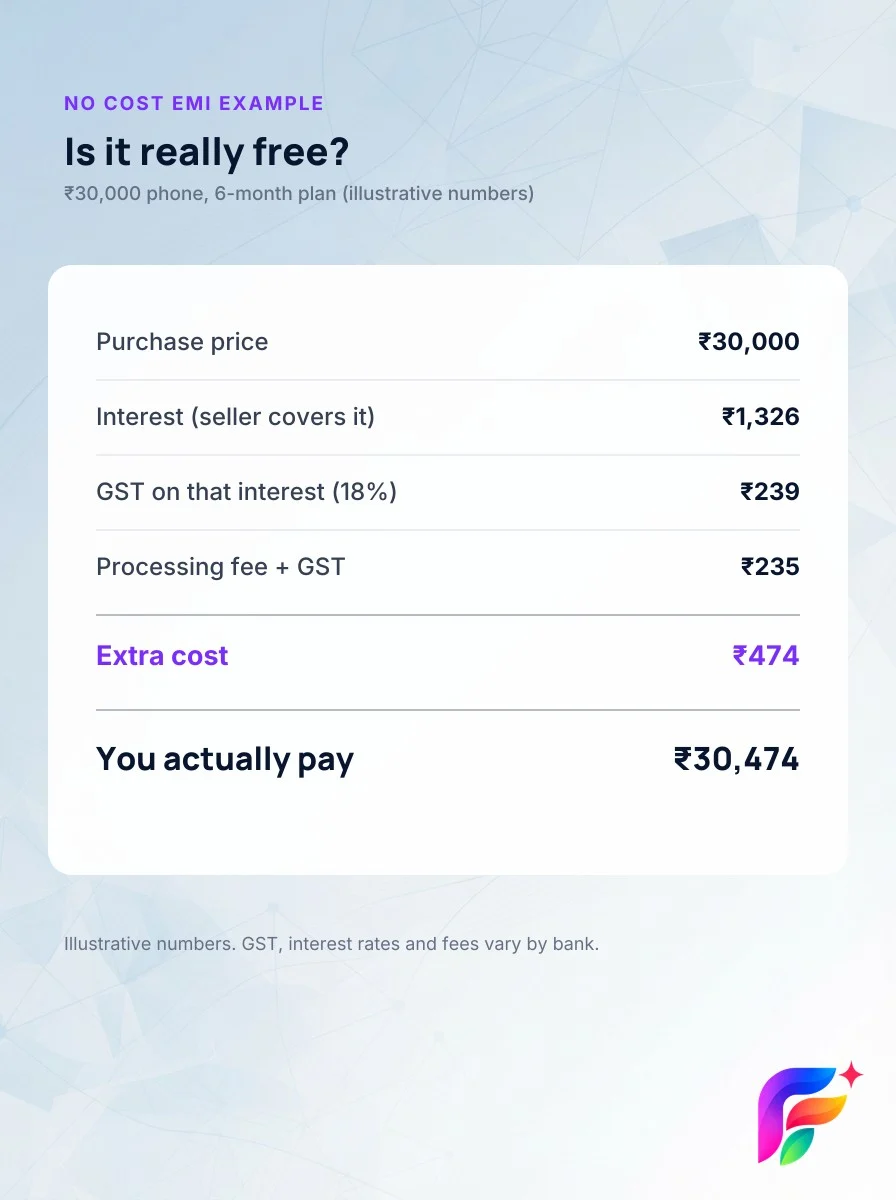
Example (illustrative numbers): a phone costs ₹30,000. You choose a 6-month No Cost EMI.
Interest at an example rate of 15% a year comes to about ₹1,326. The seller gives you a ₹1,326 discount, so the interest is covered.
GST at 18% on that ₹1,326 of interest: about ₹239.
Example processing fee of ₹199, plus 18% GST: about ₹235.
Extra cost: about ₹474. You end up paying roughly ₹30,474 for a ₹30,000 phone.
On a ₹30,000 purchase, GST and processing fees can add about ₹474 even with No Cost EMI.
That’s not a disaster. Spreading a big, planned purchase over six months can be sensible. But “No Cost” is not zero cost, and it shouldn’t be the reason you buy something more expensive than you planned.
Also check:
Does paying in full give you a bigger bank discount than choosing EMI?
Will you lose the No Cost benefit if you close the EMI early? Some banks charge foreclosure fees.
Missing an EMI payment brings late fees and high interest, and it can hurt your credit score.
Exchange Mela: trading in your old device
Exchange offers take money off a new product when you hand over an old one. The exchange value depends on the model, its condition and your pin code, and the final value is confirmed only when the pickup agent checks the device.
Before you choose exchange:
Check what you could get by selling the old device yourself or giving it to a family member.
Make sure the old device’s condition matches what you declared. If it doesn’t, the exchange value can drop at your doorstep.
Back up and factory-reset your old phone or laptop before pickup.
Buy More Save More, Combos and coupons
These offers give you a bigger discount when you buy more items, or a bundle, or tick a coupon box.
They’re useful only when every item is something you already planned to buy. If you’re adding a third item just to unlock a discount, you’re not saving money. You’re spending more to feel like you saved.
Coupons are simple: tick the coupon box on the product page before adding to cart, then check the discount actually shows up at checkout.
What the deal labels mean
Blockbuster Deals, Top 100 Deals and Mega Deals: featured deals that Amazon promotes heavily on the sale page. Being featured doesn’t make a deal better. It makes it more visible.
8 PM Deals: deals that go live at a set time. They’re built to create a rush. If the item isn’t on your list, the time slot doesn’t matter.
Lightning or limited-time deals: discounts with a timer or a limited number of units. Check the price history before letting a timer decide for you.
Is the discount real? How to check a deal in 2 minutes
This is the most useful habit you can build before the sale. It takes about two minutes per item.
Step 1: Ignore the “% off” number. The percentage is usually calculated from the MRP. Many products rarely sell at MRP, so “60% off” can look much bigger than the actual saving.
Step 2: Check the price history. Amazon now shows price history on many product pages in India. Look for a price history link near the price, or ask Amazon’s built-in AI shopping assistant something like “Has this item been cheaper in the last 90 days?” Amazon’s price history can show the last 30, 90 and up to 365 days. If you don’t see it on a product, a trusted price-tracking tool can help.
Step 3: Compare against the normal price, not the MRP. The real saving is the difference between the sale price and what the product usually sold for in the last few months.
Example
Example (illustrative numbers): a pair of sneakers shows “MRP ₹4,999, deal price ₹1,999, 60% off.”
The price history shows it sold for ₹2,099 for most of the last three months. The real saving is ₹100, not ₹3,000. That might still be fine if you need the shoes. It’s just not a reason to buy them if you don’t.
Step 4: Check one other place. Look at the brand’s own website and one other retailer for the same model. Sometimes the “sale” price is the everyday price elsewhere.
Step 5: Match the exact model. Check the model number, size, storage, colour and pack size. A deal on a lower variant, an older model or a smaller pack can look like a deal on the one you wanted.
9 sale traps that make people overspend
Sales make money partly through design choices that nudge you to spend more. India’s Central Consumer Protection Authority (CCPA) has banned 13 of these “dark patterns” under its 2023 guidelines, and in November 2025 the government said 26 e-commerce platforms, including Amazon, had submitted self-declarations saying they had checked their sites for them.
Even so, a LocalCircles audit of 290 online platforms (June to September 2025, based on 77,000 consumer responses) found that 97% were still using at least one dark pattern. 75% of users said they had faced hidden fees that appeared only at checkout.
So here’s what to watch for. Knowing the trap is usually enough to avoid it.
1. Buying the discount, not the product
This is the biggest trap, and it’s not a design trick. It’s us. “It’s 70% off” feels like a reason to buy. It isn’t. The only real reason is “I need this, and this is a fair price.” Anything you didn’t plan to buy is 100% extra spending, whatever the discount.
2. False urgency
Countdown timers, “Only 2 left”, “Deal ends soon” and “Limited time deal” labels are designed to cut your thinking time. In April 2026, MediaNama reported “Limited time deal” labels on the Amazon India app with no expiry time shown.
What to do: if a timer is the only thing pushing you, close the tab. If the item is on your list and the price history checks out, buy it calmly.
3. Hidden fees at checkout (drip pricing)
The price on the product page isn’t always the price you pay. Delivery charges, handling fees, platform fees, cash-on-delivery charges or gift-wrap charges can appear only at the final step.
What to do: compare the final amount at checkout, not the listed price.
4. Extras added to your cart (basket sneaking)
Sometimes an extended warranty, protection plan, installation or donation gets added to your cart by default.
What to do: read every line in your cart before paying. Remove what you didn’t choose.
5. Prices or offers that change at checkout (bait and switch)
A deal price or bank offer shows up on the product page, but doesn’t apply at checkout. In the LocalCircles audit, 48% of users said prices or offers changed after login or during checkout.
What to do: check that the discount appears in the final payment summary before you pay. If it doesn’t, don’t complete the order.
6. Last-minute add-on prompts
“Need anything else?” or “Frequently bought together” screens often appear just as you’re about to pay. MediaNama reported a “Need anything else?” screen on the Amazon India app between “Proceed to Buy” and payment.
What to do: have a rule. Nothing gets added at checkout that wasn’t on your list.
7. Reviews you can’t trust
Ratings can be pulled up by paid, incentivised or copied reviews. India’s Bureau of Indian Standards has a standard for online consumer reviews (IS 19000:2022), but it’s voluntary.
What to do:
Read the 3-star and 1-star reviews, not just the 5-star ones.
Look for detail: size, fit, how long they’ve used it, real problems.
Be careful with many short, similar reviews posted around the same dates.
Check that the reviews are for the same product, not a different variant bundled into the same page.
8. The wrong seller, variant or warranty
The same listing can have several sellers, and the model details can differ.
What to do: check “Sold by” and the seller’s rating, look for brand warranty valid in India, and match the model number with the brand’s own website.
9. Fake sale links and scam messages
Festive sales bring a wave of fake “Amazon sale” links on WhatsApp, SMS and social media, often with unbelievable prices, prize claims or fake “order problem” messages.
What to do:
Shop only through the official Amazon app or by typing amazon.in yourself.
Don’t click sale links from unknown numbers, even if they look official.
Never share your OTP, card PIN or UPI PIN with anyone who calls or messages about an order.
If you lose money to a scam, call the national cybercrime helpline 1930 immediately or report it at cybercrime.gov.in.
The simplest defence against all nine traps: decide what you’re buying and how much you’ll spend before you open the app.
Before you buy: returns, warranty and seller checks
A good price isn’t a good deal if you can’t return a faulty product. Check these three things on the product page before you order.
1. The return policy for that item. Return rules differ by category and sometimes by product. Some items can be returned for a refund. Others, especially many electronics, can only be replaced if they’re faulty or damaged. Some beauty and personal care items can’t be returned once opened. Read the “Returns” line under the price on the product page.
2. The warranty. Check whether the product comes with a brand warranty valid in India, how long it lasts and how to claim it. Keep your invoice.
3. The seller. Check who the seller is, their rating and whether the item is fulfilled by Amazon. For expensive items, record a short unboxing video. It makes any “wrong or damaged item” complaint much easier.
Your pre-sale plan: 7 steps to follow before 7 October
This is the part that saves you money. Do it once, before the sale opens.
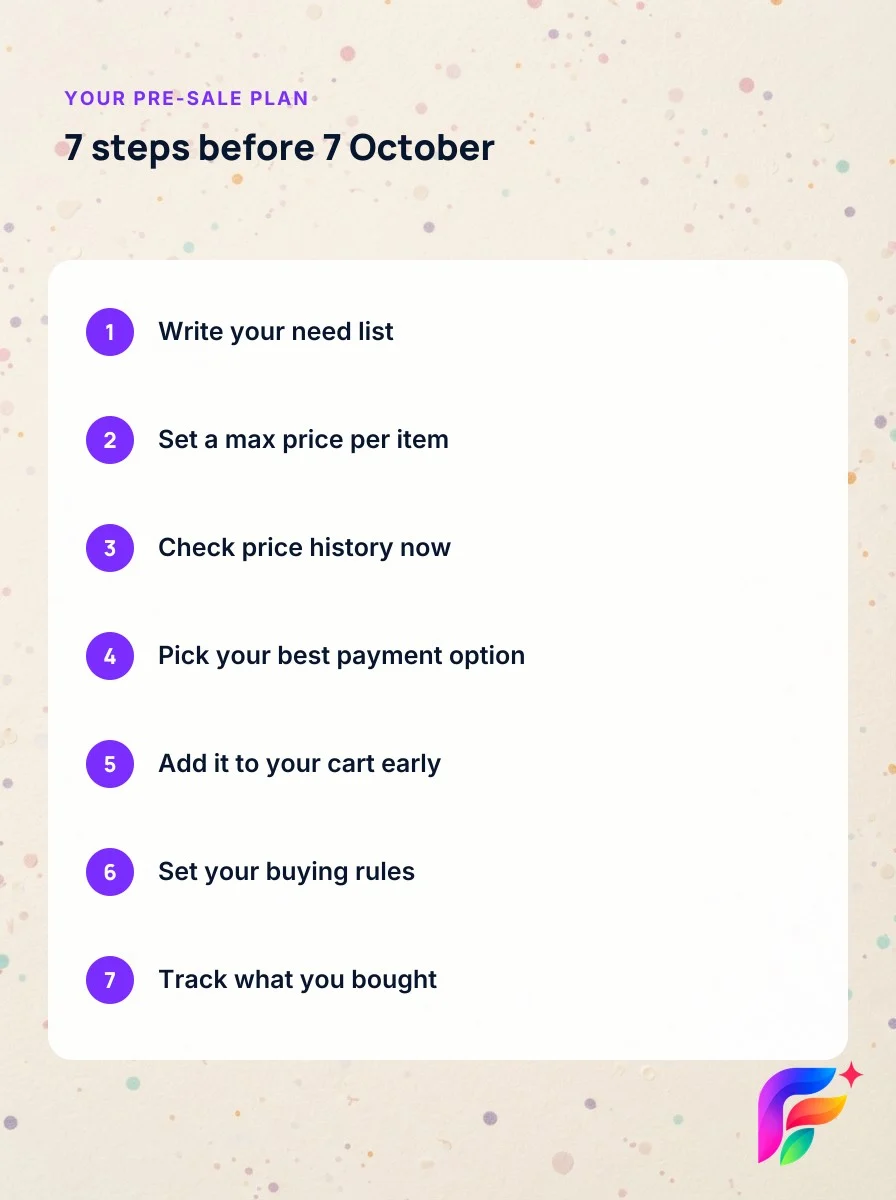
Write your need list. Only things you’d buy even without a sale: a phone that’s actually failing, a festive outfit for a specific event, a restock of what you already use, Diwali gifts for specific people.
Set a maximum price for each item. Write the number next to it. This is your walk-away price.
Check each item’s price history now. Note its normal price over the last few months. That’s how you’ll know a real deal when you see one.
Work out your best payment option. Which card, bank offer or payment method gives the lowest final price on your list? Remember the caps and minimums.
Add everything to your wishlist or cart early. On sale day, you’ll only need to compare the price against your notes.
Set your rules. Nothing gets added that isn’t on the list. No buying because of a timer. No adding items to unlock a combo discount.
Track what you bought. Note the return window for each order and check items as soon as they arrive.
Do this once, before the sale opens.
Want this checklist in your inbox?
Join the FIND N FORM newsletter for practical buying advice before every big sale. No spam, no deal overload.
What’s worth buying in fashion, beauty, personal care and lifestyle
Here’s the honest version: a sale is worth it for things you already planned to buy, and not worth it for things you only noticed because they were on sale.
Below, we’ve gone through the categories FIND N FORM covers and noted when the sale makes sense, when to skip, and what to check. We’re not recommending any specific product here. Each button takes you to the category on Amazon, so you can compare options yourself using the checks in this guide.
Fashion: what to buy and what to skip
Festive season is when a lot of Indian wardrobes get refreshed, so fashion is one of the most tempting parts of the sale. It’s also where impulse buys pile up fastest.
Festive ethnic wear
Worth buying in the sale if: you have a specific occasion coming up, like Durga Puja, Diwali or a wedding, and you know your size in that brand.
Skip or wait if: you’re buying “just in case” or following a trend you’re not sure about.
Check before you buy: the brand’s size chart, fabric details and whether the item is returnable.
Worth buying in the sale if: you’re replacing an item you’ve finished or you know the exact shade you want.
Skip or wait if: you’re buying a big palette or a full set for one look.
Check before you buy: shade names against the brand’s official shade guide, expiry dates, and the return rule, since many opened beauty products can’t be returned.
Personal care is a good place for planned sale buying, because you use these products every day. The trick is to buy what you use, not what looks nice in a combo pack.
Trimmers and grooming devices
Worth buying in the sale if: your current trimmer or shaver is failing, or you’ve already decided which type suits you.
Skip or wait if: you’re upgrading a working device for an extra attachment you won’t use.
Check before you buy: the warranty, battery and charging type, and whether blades or heads are easy to replace in India.
Lifestyle is where the “this would be nice to have” feeling is strongest. Useful home and travel buys can make daily life easier. Clever gadgets you saw in an ad usually don’t.
Luggage and travel bags
Worth buying in the sale if: you have festive or winter travel planned and your current bag is damaged or the wrong size.
Skip or wait if: you travel once a year and your old bag still works.
Check before you buy: the dimensions against your airline’s cabin rules, the weight of the empty bag, and the warranty.
Links to Amazon are affiliate links. Prices and deals change often, so check the current price on Amazon.
If something goes wrong: how to get help
Most orders arrive fine. If one doesn’t, here’s the order to follow:
Contact Amazon customer service through “Your Orders” in the app. Choose the order, explain the problem clearly, and keep screenshots and your unboxing video if you have one.
If the problem isn’t solved, contact the National Consumer Helpline (NCH) by calling 1915 or through the official website, consumerhelpline.gov.in.
For unresolved disputes, you can file a consumer complaint online through the government’s e-Daakhil portal.
For fraud or scams, call the cybercrime helpline 1930 or report at cybercrime.gov.in.
Our verdict: is the Amazon Great Indian Festival worth it?
Yes, if you arrive with a list. No, if you arrive with free time.
The sale can save you real money on things you already planned to buy, especially bigger purchases you’ve researched and price-checked in advance. But the same sale that saves you ₹2,000 on a planned phone can cost you ₹5,000 in things you never needed.
Make the list. Set your prices. Check the history. Then let the sale work for you.
Don’t shop the sale. Shop your list.
Frequently asked questions
When does the Amazon Great Indian Festival 2026 start?
The main sale starts on 8 October 2026, as confirmed by Amazon. Prime members are expected to get 24-hour early access from 7 October, and early deals are already showing in the Amazon app.
When does the Amazon Great Indian Festival 2026 end?
Amazon hasn’t announced the end date yet. The 2025 sale ended on 20 October 2025. We’ll update this answer once Amazon confirms the 2026 date.
Is the Great Indian Festival only for Prime members?
No. The sale is open to everyone from 8 October. Prime members get early access and may get extra savings on eligible deals.
Which bank offer is available in the Amazon Great Indian Festival 2026?
Amazon has confirmed a 10% instant discount on SBI Credit and Debit Cards, including EMI transactions. The offer has a maximum discount and conditions such as minimum order value, so check the terms on the product page before paying.
Is No Cost EMI really free?
Not completely. The seller covers the interest through a discount, but you usually still pay 18% GST on the interest and a one-time processing fee, plus GST on that fee. On a ₹30,000 purchase over six months, that can add a few hundred rupees.
Are Amazon sale discounts real?
Some are, some aren’t as big as they look. The “% off” is usually calculated from the MRP, which may be higher than the price the product normally sells at. Check the product’s price history to see the real saving.
How can I avoid overspending in the Amazon sale?
Make a list with a maximum price for each item before the sale, check price history, buy only what’s on the list, and ignore timers and combo offers for things you didn’t plan to buy.
Should I buy now or wait for a later sale?
If you need it now and the price is at or below its usual price, buy it. If you don’t need it now, there’s no rush. Amazon runs several big sales every year.
How we researched this guide: we used Amazon’s official announcements, government and consumer-research sources, and public reporting from September 2026. We did not test products for this guide, and it does not recommend any specific product. Examples with numbers are illustrative and are labelled as such.
Affiliate disclosure: As an Amazon Associate I earn from qualifying purchases. FIND N FORM is not owned, sponsored or endorsed by Amazon.
One response to “Amazon Great Indian Festival 2026: Dates, Offers and How to Avoid Sale Traps”
[…] rather than the discount percentage. If you are shopping during the festival sales, our guide to the Amazon Great Indian Festival 2026 and how to avoid sale traps walks through checking price history before you […]







[…] rather than the discount percentage. If you are shopping during the festival sales, our guide to the Amazon Great Indian Festival 2026 and how to avoid sale traps walks through checking price history before you […]