1200W or 2000W? What hair dryer wattage really changes, which suits your hair, socket and inverter, and what to check before you buy in India.
We may earn a commission when you buy through links on this page. This never changes what we recommend. As an Amazon Associate I earn from qualifying purchases.
You open Amazon to buy a hair dryer and the numbers start piling up: 1000W, 1200W, 2000W, even 2800W. Every listing promises salon results. Not one of them tells you what those watts actually do for your hair.
That is the confusing part of working out how to choose a hair dryer in India. Does more watts mean faster drying, more damage, or just a bigger electricity bill?
Get it wrong one way and long hair takes forever to dry on a sticky monsoon morning. Get it wrong the other way and the dryer runs hotter than your hair needs, trips your inverter, or asks too much of an old wall socket.
This guide explains what wattage really changes, which wattage suits your hair and your home, and when 1200W is all you need.
Quick answer: 1200W or 2000W?
If you are working out how to choose a hair dryer in India, start with your hair, not the watt number. For short, fine or medium hair that you dry a few times a week, a 1200W dryer is usually enough. For long, thick or curly hair, or daily drying, an 1800W to 2000W dryer makes more sense. Airflow, heat control, a cool shot button, weight and the ISI mark matter just as much. With 2000W, use a sturdy, good-quality socket and skip cheap extension boards.
What this guide covers:
What hair dryer wattage really means, and why watts are not the same as speed
The real differences between a 1200W and a 2000W dryer
Whether a 2000W dryer suits your home socket, inverter and electricity bill
Which wattage suits your hair type, in one simple table
Eight things to check before you buy, including the ISI mark
What the research says about heat damage, and five research-based picks
What Does Hair Dryer Wattage Actually Mean?
Wattage tells you how much power a dryer pulls from the wall socket. Most of that power goes into the heating coil. A smaller share runs the motor and fan that push the air out.
More watts generally means more heat, and it can mean stronger airflow too. But the number alone does not promise faster drying, because the motor and fan decide how much air reaches your hair.
Think of wattage like engine size, and airflow like how fast the car really moves. A well-designed smaller engine can keep up with a bigger one that wastes its power. So when you compare hair dryer watts, treat the number as a starting point, not the final answer.
Common wattage ranges in India
Indian brands tend to group their dryers into rough bands. This is a guide brands use, not a fixed rule.
Wattage range
Typical use
Who it usually suits
About 800 to 1400W
Compact dryers, light or occasional use, travel
Short or fine hair, quick touch-ups
About 1400 to 1800W
Everyday mid-range dryers
Medium hair, regular use, shared family dryers
1800W and above
Faster drying for heavier hair loads
Long, thick or curly hair, daily drying
Common hair dryer wattage ranges in India
An 1800 watt hair dryer sits right where the everyday band meets the high-power band. That is why many households that share one dryer end up somewhere between 1600W and 2000W.
1200W vs 2000W Hair Dryer: The Real Differences
The short answer: a 2000W dryer dries long and thick hair faster, while a 1200W dryer is usually lighter, gentler at its top setting and enough for shorter or finer hair.
Criterion
1200W
2000W
Why it matters
Best for
Short, fine or medium hair, occasional use
Long, thick or curly hair, daily use
Matches how much hair you dry
Drying speed
Slower on thick hair
Faster, with more air and heat
Time on busy mornings
Heat output
Gentler at the highest setting
Hotter at the highest setting, needs care
Damage risk if held too close
Weight and size
Often lighter, often foldable
Often bigger and heavier
Arm tiredness, travel
Current draw
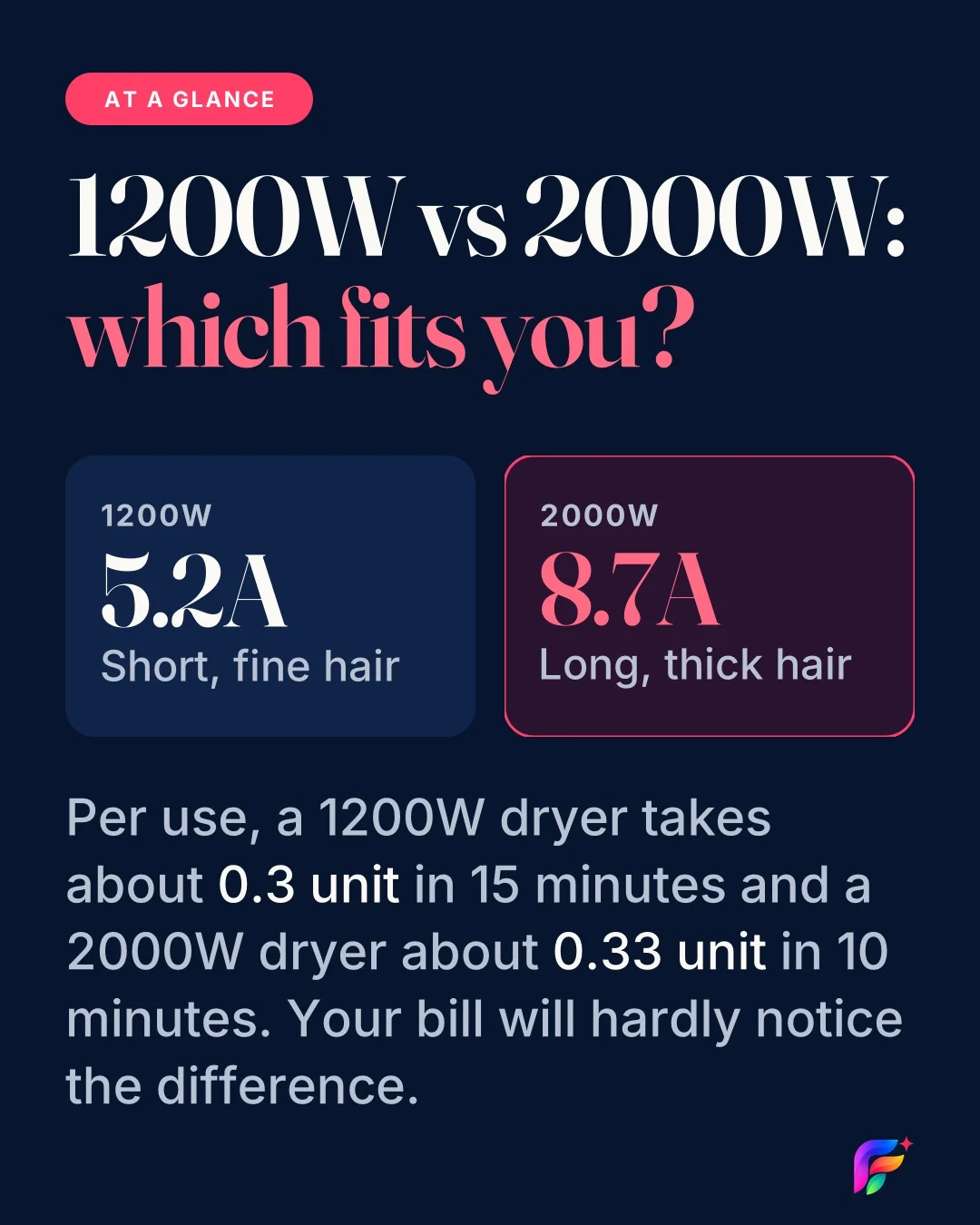
About 5.2A
About 8.7A
Socket and inverter safety
Electricity per use
About 0.3 unit (15 minutes)
About 0.33 unit (10 minutes)
The difference is small
Price band
Usually lower
Usually higher
Check current prices before you decide
1200W vs 2000W hair dryer at a glance
1200W vs 2000W at a glance: current draw and electricity per use.
The electricity row assumes the 2000W dryer finishes in 10 minutes and the 1200W dryer in 15, since stronger dryers usually finish sooner. Your own times will depend on your hair.
Is a 1200 watt hair dryer good?
Yes. A 1200 watt hair dryer is a good choice for short, fine or medium hair that you dry a few times a week. It is often lighter and more compact, and it runs gentler at its highest heat.
Its limit shows with long or thick hair. More hair holds more water, so a 1200W dryer can take noticeably longer, and humid monsoon air slows drying further. If you have that kind of hair and dry it daily, the extra time adds up.
So is 1200W enough for a hair dryer? For a lot of people, yes. Do not let a bigger number talk you out of a dryer that already fits your hair.
Is a 2000 watt hair dryer good?
Yes. A 2000 watt hair dryer is a good choice if you have long, thick or curly hair, dry your hair every day, or share one dryer across the family. The extra power mostly buys you time.
That power needs a little care. Start on medium heat, keep the dryer moving and keep your distance (see the heat damage section). Check your socket too, because a 2000W dryer draws more current than a regular 6A socket is rated for.
What about 1000W, 1600W and 1800W?
A 1000W dryer is a basic option for travel, short hair or quick touch-ups. A 1600W to 1800W dryer is a sensible middle ground for many Indian households. It dries medium and longer hair faster than 1200W without the extra heat and current of a 2000W model.
Is a Higher Watt Hair Dryer Always Better?
No, a higher watt hair dryer is not automatically better. More watts mostly means more heat. Faster drying also depends on how well the dryer moves air.
Airflow and motor type matter too
The motor and fan decide how much air the dryer pushes. That airflow carries water away from your hair, so it matters as much as heat.
Many home dryers, including two of our picks, use a DC motor, according to their makers. Newer high-speed dryers use brushless (BLDC) motors that spin very fast. These can dry hair quickly at a moderate wattage, because they lean more on air speed and less on high heat.
Be careful with very high wattage claims
If a low-priced dryer from a brand you have never heard of claims 2800W or more, give it a second look. A big watt number is easy to print on a box, and as we saw above, watts are not the same as speed.
The simplest check is the ISI mark. Since 2025, hair dryers sold in India must be certified by the Bureau of Indian Standards under the BIS Quality Control Order for skin and hair care appliances, which uses the safety standard IS 302 (Part 2/Sec 23).
Look for the ISI mark and a licence number on the product, the box or the listing. If you cannot find either, choose another dryer.
Will a 2000W Hair Dryer Work Safely at Home?
Usually yes, as long as you plug it into the right socket. What you need to check is the plug, socket and wiring, not just the dryer.
The socket question
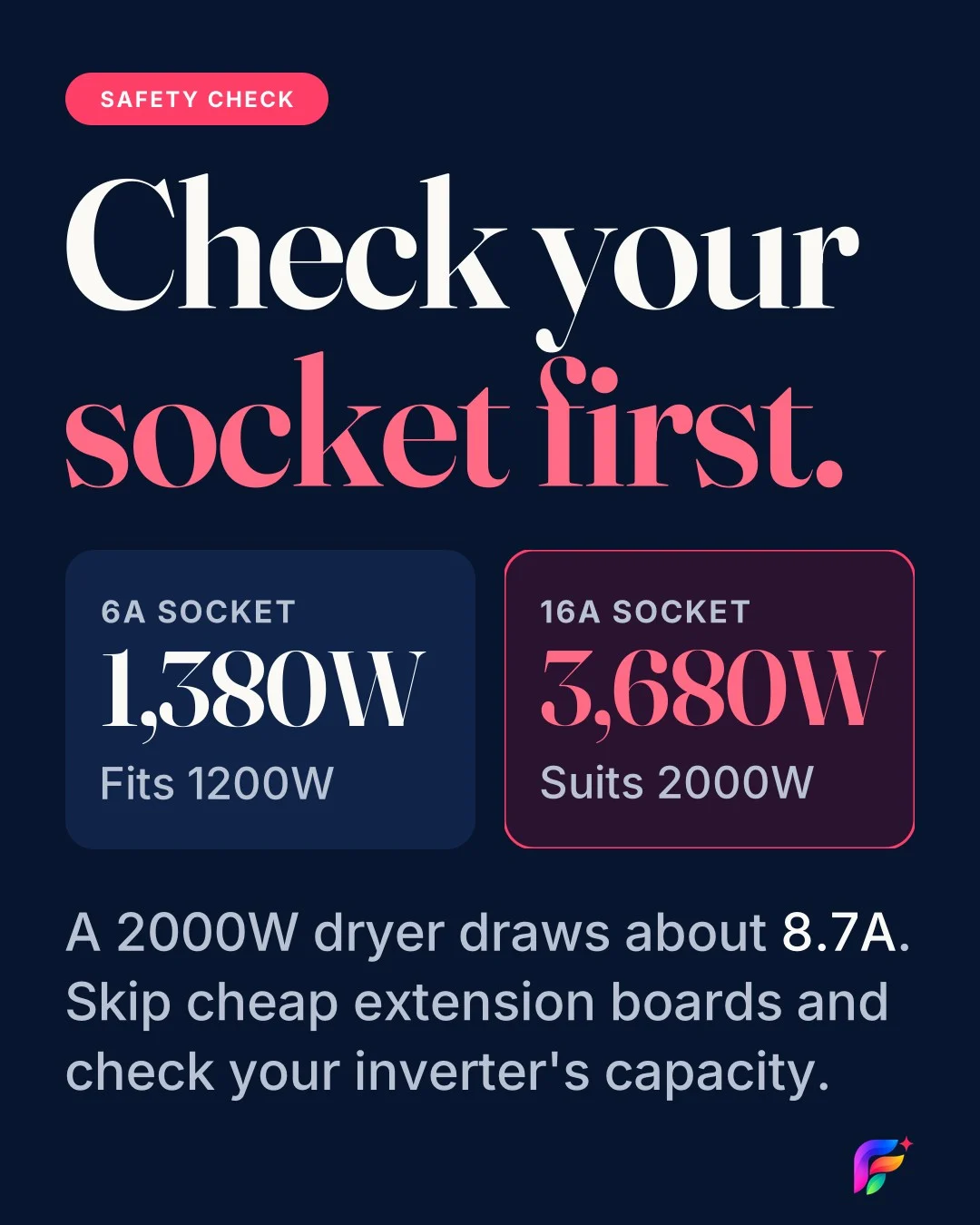
Most Indian homes have two kinds of three-pin sockets under the standard IS 1293: the regular 6A socket and the bigger 16A socket used for heavier appliances like geysers. At 230V, a 6A socket is rated for about 1,380W. A 16A socket is rated for about 3,680W.
Now the dryer side. Current (amps) is watts divided by volts.
A 1200W dryer draws about 5.2A, which sits inside a 6A socket’s limit. A 2000W dryer draws about 8.7A, which is more than a 6A socket is rated for.
That does not mean a 2000W dryer will fail the moment you switch it on. It means that on a 6A socket, the plug and socket are working above what they were designed for, so their quality and condition matter a lot. A 16A socket is the better match for a 2000W dryer.
Check the plug before you buy. Many dryers come with a small 2-pin plug, while some higher-watt models have a larger 3-pin plug that only fits a 16A socket.
Socket check: a 2000W dryer draws about 8.7A, more than a 6A socket is rated for.
A practical safety checklist:
Plug the dryer straight into a firm, good-quality wall socket.
Avoid multi-plug adapters and cheap extension boards, especially with a 2000W dryer.
If the plug or socket gets hot, or you smell burning, switch off and call an electrician.
Never use a dryer near water, such as a filled bucket or a wet bathroom floor.
Will it run on a home inverter?
Maybe not. Many home inverters are sized for fans, lights and a TV, not for a heating appliance that pulls 1200W to 2000W.
Check your inverter’s rated capacity on its label or in its manual before using any high-wattage dryer during a power cut. If the dryer needs more than the inverter can supply, it may trip, so wait for mains power.
Does a 2000W dryer increase the electricity bill?
Only slightly. Electricity is billed in units, and one unit is one kilowatt-hour. You get units by multiplying watts by hours and dividing by 1,000.
Dryer
Time
Units used
1200W
15 minutes
0.30 unit
2000W
10 minutes
About 0.33 unit
2000W
15 minutes
0.50 unit
Hair dryer electricity use per session
Even if you dry daily for 15 minutes, the gap between 1200W and 2000W is 0.2 unit a day, or about 6 units in a 30-day month. Tariffs vary by state, but the bill should not be what decides your wattage. Your hair type and drying time should.
Which Wattage Suits Your Hair Type?
Match the wattage to how much hair you dry and how often, not to the biggest number on the box. Use this table as a starting point.
Hair type or situation
Suggested range
Feature to look for
Watch out for
Short or fine hair
1000 to 1200W
At least 2 heat settings
Too much heat
Medium, normal hair
1200 to 1600W
Cool shot
Nothing major
Long or thick hair
1800 to 2000W or more
Concentrator nozzle, more than one speed
Weight, heat
Curly or wavy hair
1600 to 2000W
Diffuser, a low speed option
Strong, fast air can add frizz
Men with short hair
1000 to 1200W
Compact and light
Paying for power you will not use
Shared family dryer
1600 to 2000W
Several heat and speed settings
Socket safety
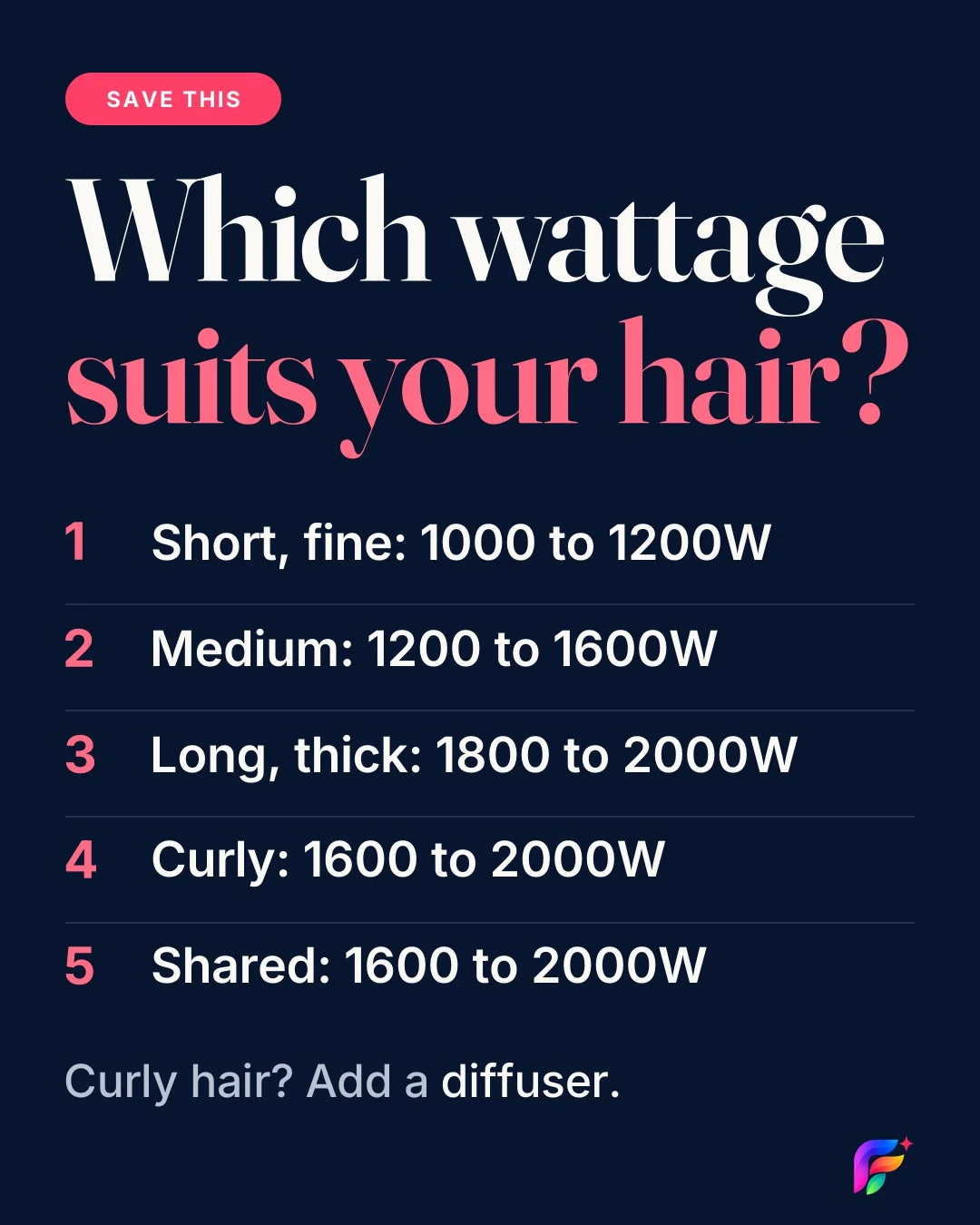
Hair dryer wattage by hair type
Which wattage suits your hair: a quick guide to save.
If you have been wondering what wattage hair dryer is best for thick hair, it is usually 1800W to 2000W, with a concentrator nozzle to aim the air. For fine hair, 1000W to 1200W with a low heat setting is usually plenty.
Curly hair is a special case. A hair dryer with a diffuser for curly hair spreads the airflow out, so curls dry without being blown apart. Pair it with a low speed setting.
Indian conditions push some people up a band. Humid monsoon months slow drying, long hair is common, and many families share one dryer. If that sounds like your home, the 1600W to 2000W range is a sensible choice.
8 Things to Check Before You Buy a Hair Dryer in India
Does a good hair dryer really make a difference? Yes, mostly through control: the right settings, a cool shot, a comfortable weight and proper safety features. Check these eight things before you buy.
1. Wattage that matches your hair
Start with the hair type table above and pick the band that fits your hair and how often you dry. One band higher can make sense for a shared dryer. Two bands higher usually just adds heat and weight.
2. Heat and speed settings
Look for at least two heat settings plus a cool shot. Low heat protects fine hair, and high heat saves time on thick hair.
Separate speed control is a plus, because it lets you pair gentle heat with strong air. Some dryers only offer preset combinations, so check how the settings work.
3. Cool shot button
A cool shot button switches the heater off while the fan keeps running, so you get a burst of cool air. Many people use it at the end to help set a style. A hair dryer with a cool shot also gives your scalp a short break during long drying sessions.
4. Attachments: concentrator and diffuser
A concentrator is a narrow nozzle that focuses the air into a flat stream. It helps with straight styles and with drying long hair section by section.
A diffuser is a wide, bowl-shaped attachment that spreads the air gently, which suits curly and wavy hair. If you have curls, check that a diffuser is in the box.
5. Ionic and ceramic claims
Brands say ionic technology releases negatively charged ions that reduce frizz and static. Philips, for example, says its advanced ionic care releases up to 20 million ions per drying session. Ceramic parts are described as spreading heat more evenly.
These are manufacturer claims, and evidence varies by hair type, so treat an ionic hair dryer as a nice extra rather than a reason to stretch your budget. We will compare ionic vs ceramic hair dryer options in a separate guide.
6. Weight, foldable handle and cord length
Weight matters if you dry long hair daily. Havells lists its 1200W HD3151 at 335 g, and bigger high-watt dryers often weigh more.
A foldable hair dryer packs smaller, which makes it a better travel hair dryer. A 1.5 to 1.8 m cord suits most Indian dressing tables, where the socket is rarely next to the mirror.
First, check for the ISI mark and a BIS licence number, which have been mandatory for hair dryers in India since 2025. Second, look for overheat protection, which cuts power if the dryer gets too hot.
Third, a removable filter or inlet cover makes it easy to clear lint and hair, which helps the dryer breathe. Apply these checks even on a tight budget.
8. Warranty and service network
A hair dryer is a heating appliance used several times a week, so warranty matters. Four of our five picks list a 2-year brand warranty. Brands with Indian service networks are usually easier to deal with, so check the warranty and service process before you buy.
Does Using a Hair Dryer Damage Hair?
Heat can damage hair, but how you use the dryer matters more than its wattage. Holding a dryer too close on high heat is the real risk, not owning a 2000W model.
A 2011 study in the Annals of Dermatology (Lee and colleagues) looked at this directly. The researchers dried hair samples in five different ways, 30 times each, and compared them.
One group dried naturally. The others used a dryer at 15 cm for 60 seconds (about 47°C at the hair), at 10 cm for 30 seconds (about 61°C) and at 5 cm for 15 seconds (about 95°C).
They found that the dryer caused more damage on the surface of the hair than natural drying. But in their words, “using a hair dryer at a distance of 15 cm with continuous motion causes less damage than drying hair naturally.”
This was one lab study on hair samples, so it is not the final word. But it supports a simple, practical idea: distance and movement matter.
Safe-use tips:
Keep the dryer about 15 cm (roughly a hand’s length) away from your hair.
Keep it moving. Do not hold it on one spot.
Start on medium heat and use high heat only if you need it.
Finish with the cool shot.
Use a heat protectant spray if you like. Features like Philips’ ThermoProtect are hair dryer heat protection claims from the brand.
Clean the filter regularly so the dryer does not overheat.
Will a hair dryer cause hair fall? No dryer causes or prevents hair fall in a medical sense. Hair fall has many possible causes, so if it worries you, see a dermatologist rather than changing your dryer.
Our Research-Based Picks: 1200W and 2000W Hair Dryers Worth Checking
We have not tested these dryers ourselves. We shortlisted them by comparing wattage, heat and speed settings, safety features, weight, warranty and availability, using manufacturer information and listing details checked on 2 October 2026. We picked models from established brands with service networks in India.
There is no single best hair dryer for women in India, or for anyone else, because the right one depends on your hair. These five are good hair dryer options in India from 1200W up to 2100W.
Links below go to Amazon India. We earn a small commission if you buy, at no extra cost to you.
1200W everyday pick: Philips BHC010/10, 1200W
Best for: Short, fine or medium hair, light everyday use and travel.
Why it’s on our list: A compact 1200W dryer with a foldable handle, which suits a small dressing table or a travel bag. Philips says it has 3 pre-selected drying settings, a cool air setting and ThermoProtect, which Philips describes as a gentler temperature setting.
Key specs: 1200W | 3 pre-selected heat and speed settings | Cool air setting | Foldable handle | 1.5 m cord | Nozzle included (per Philips)
What we like: Small and foldable, with a nozzle included for focused drying.
Limitation: Heat and speed come as 3 preset combinations, so you cannot choose high speed with low heat separately.
Consider instead if: You have long or thick hair and want faster drying. Look at the VEGA 2000W pick below.
1200W alternative with cool shot: Havells HD3151, 1200W
Best for: Short or medium hair, and anyone who wants separate heat and speed settings at 1200W.
Why it’s on our list: Havells lists separate heat (hot and warm) and speed settings plus a cool shot, which is more control than most 1200W dryers offer. It also lists double protection against overheating and a honeycomb inlet that Havells says helps stop hair tangling in the dryer.
Key specs: 1200W | 2 heat, 2 speed settings | Cool shot: yes | 335 g | 1.6 m cord | 2-year warranty (all per Havells)
What we like: Separate heat and speed buttons, and light at 335 g.
Limitation: Havells lists only a concentrator nozzle, so there is no diffuser for curly hair.
Consider instead if: You have curls (you need a diffuser) or long, thick hair.
2000W pick for long or thick hair: VEGA Dry-Up VHDH-36, 2000W
Best for: Long, thick hair, daily drying, or a dryer shared by the family.
Why it’s on our list: VEGA lists 2000W from a DC motor, 3 heat settings, a cool shot, a foldable handle and an automatic overheat cut-out. VEGA also says the dryer is BIS compliant.
What we like: An overheat cut-out and a removable filter cover, both useful on a high-watt dryer.
Limitation: Only one speed setting, so you cannot lower the airflow for curly hair or a gentle finish. VEGA does not list the plug type, so check it on the listing before you buy.
Consider instead if: You want more than one speed, or only have 6A sockets near your mirror (try the 1600W pick). The Havells HD3276 is a 2000W alternative listed with 2 heat settings, a cool shot, a thin concentrator and a brush.
Middle ground if you are unsure: Philips BHD318, 1600W
Best for: Medium to long hair, or a household that cannot decide between 1200W and 2000W.
Why it’s on our list: At 1600W it sits between the two main wattage bands. Philips lists 3 heat and speed settings, and says its ThermoProtect attachment mixes warm and cool air to drop the temperature by 10°C.
Step up if you dry daily and want more control: Philips BHD356, 2100W
Best for: Long or thick hair dried every day, by someone who wants fine control over heat and speed.
Why it’s on our list: Philips lists 6 heat and speed settings, the widest range here. Philips says its ThermoProtect attachment drops the temperature by 15°C, and claims advanced ionic care.
A 2000W dryer is not the right buy for everyone. You can probably skip it if you are:
Someone with short or fine hair who dries it only now and then
A frequent traveller who wants a light, foldable dryer
Living in a home with old wiring, or with only loose 6A sockets near the mirror
Mainly using a dryer for quick touch-ups
For most men with short hair, the best hair dryer for men is simply a light, compact 1000W to 1200W model. If any of this sounds like you, a good 1200W dryer is the smarter buy.
Final Verdict: How to Choose a Hair Dryer in India
The simplest way to think about how to choose a hair dryer in India is this: buy for your hair, then check your home.
Choose 1200W for lighter, shorter hair and occasional use. Choose 1800W to 2000W for long, thick or curly hair and daily use. Whatever you choose, check the heat settings, cool shot, ISI mark and your socket.
A 1200W dryer is not a compromise if your hair is short or fine. It is the right tool. A 2000W dryer earns its place when you have a lot of hair to dry, used on medium heat, a hand’s length away, in a sturdy socket.
A 1200W hair dryer is usually the better buy for most people, because the extra power dries medium hair noticeably faster. A 1000W dryer is fine for very short hair, quick touch-ups or travel. If your hair reaches your shoulders or beyond, 1200W or more will save you time.
How many watts is a good hair dryer for home use?
For most homes, 1200W to 1800W is a good range for a hair dryer. Go for 1200W if your hair is short or fine, and 1600W to 2000W if it is long or thick, or if the whole family shares one dryer. The 1200W vs 2000W hair dryer choice mostly comes down to hair length and thickness.
Is a 2000 watt hair dryer too hot for fine hair?
A 2000W hair dryer can be too hot for fine hair if you use its highest setting up close. Fine hair dries quickly, so it rarely needs that much heat. If you already own one, use the low or medium heat setting, keep it about 15 cm away and keep it moving.
Can I use a 2000W hair dryer in a normal socket?
You can, but a 2000W dryer draws about 8.7A, which is more than a regular 6A socket is rated for. A 16A socket is the better match. If you use a 6A socket, make sure it is firm and in good condition, avoid extension boards, and stop if the plug or socket gets hot.
Does a hair dryer use a lot of electricity?
No. A 1200W dryer used for 15 minutes uses about 0.3 unit of electricity, and a 2000W dryer used for 10 minutes uses about 0.33 unit. Even with daily use, the difference between the two is around 6 units a month. Tariffs vary by state, but the cost per session is small.
Is an ionic hair dryer worth it?
An ionic hair dryer can be worth it if frizz and static bother you, but treat it as an extra, not a must. Brands say ions reduce frizz and static, and the evidence varies by hair type. Heat control, a cool shot and the right wattage usually make a bigger difference to your results.
What is the difference between a hair dryer and a blow dryer?
In everyday Indian usage, a hair dryer and a blow dryer mean the same thing. “Blow dry” often refers to styling with a round brush while you dry, usually with a concentrator nozzle to focus the air. Any hand-held hair dryer can be used to blow dry.
Can I carry a hair dryer on a flight?
Corded hair dryers are generally allowed on Indian flights, in both cabin and checked baggage. Cordless dryers with lithium batteries usually follow stricter battery rules. Rules can change and differ between airlines, so check your airline’s current baggage rules before you fly.
Affiliate disclosure: We may earn a commission when you buy through links on this page. This never changes what we recommend. As an Amazon Associate I earn from qualifying purchases. Read our full affiliate disclosure.
About the author: Atoofa Khushnood is a writer, journalist and digital marketer at FIND N FORM. She writes research-based buying guides that help Indian readers compare products before they spend. This guide is based on manufacturer information, listing details and published research, not personal use of the products. Last reviewed: 2 October 2026.
Sources:
Lee Y, et al. “Hair Shaft Damage from Heat and Drying Time of Hair Dryer.” Annals of Dermatology, 2011;23(4):455-462. Read the study
Electrical Appliances for Skin or Hair Care (Quality Control) Order, 2023, S.O. 1125(E), and IS 302 (Part 2/Sec 23): 2009. QCO summary
IS 1293 socket types (6A and 16A), as explained at sidverma.io. Wattage and current figures are our own calculations.
Manufacturer product information from Philips India, Havells and VEGA, checked on 2 October 2026.
Want to know how FIND N FORM researches products? Read more about FIND N FORM.




Leave a Reply