FIND N FORM may earn a commission if you buy through links on this page, at no extra cost to you. As an Amazon Associate, we earn from qualifying purchases.
Every beard trimmer listing sounds the same. Here is what actually separates a trimmer that lasts from one that frustrates you within a month.
Most beard trimmer listings look the same after a while. Every box promises precision, every description says “professional grade,” and every price seems to fit a different budget for reasons that are never explained. You end up picking one based on the star rating or the brand name you already recognize, and hoping it works out.
A trimmer is a small purchase, but a bad one is annoying in a very specific way. It pulls hair instead of cutting it, the guard slips out of line, or the battery dies halfway through a trim before an important morning. None of that shows up in a spec sheet. This guide breaks down what actually separates a trimmer that lasts from one that frustrates you within a month, so you can judge a listing on the things that matter instead of the marketing around it.
Quick answer: A good beard trimmer for men comes down to five things: steel blades that hold an edge, a wide enough guard range to go from stubble to a longer beard, enough runtime to get through a full trim on one charge, wet-and-dry use if you trim in the shower, and blades you can clean or replace. Past the cheapest bracket, extra price usually buys finish, battery life and warranty support rather than a sharper cut.
Why “Best” Depends on Your Beard, Not the Trimmer
Review roundups tend to crown one overall winner, which is a little misleading. A trimmer built for keeping stubble neat and one built for maintaining a full, longer beard are not solving the same problem, even if they look similar in photos. Someone who trims every two or three days needs a machine that starts fast and handles short, dense hair cleanly. Someone maintaining a beard that has grown out for months needs a wider guard range and a motor that will not bog down in thicker growth.
Keep your own routine in mind while reading the rest of this guide. The “right” trimmer is the one that matches how often you trim and how long you let your beard grow between trims, not the one with the longest feature list.
What Actually Matters When Buying a Beard Trimmer
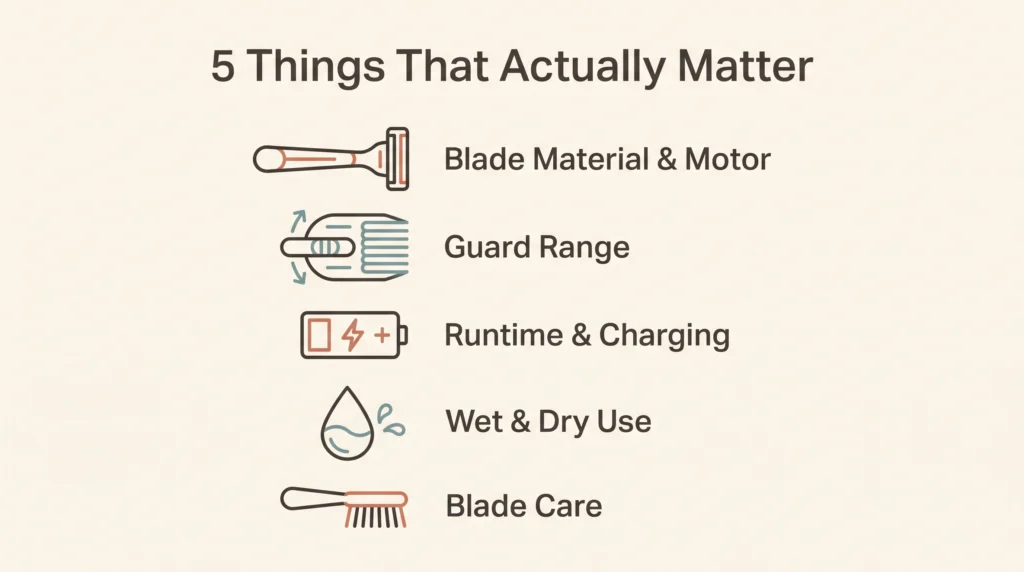
Strip away the marketing language and every beard trimmer comes down to the same five decisions.
Blade material and motor. Stainless steel blades hold an edge longer than cheaper alloy blades and are easier to find replacements for later. Self-sharpening blades are a genuine convenience, not just a marketing term, since they reduce how often you need to buy a replacement head. A weak motor is the main reason budget trimmers snag or pull hair in thicker areas of a beard, so it matters more than blade count.
Guard range. Check the shortest and longest guard length, not just how many guards are in the box. A trimmer that only goes up to 10mm will not help if you are growing out a longer beard, and one that starts at 3mm will not give you a clean stubble length. Match the range to where your beard actually sits today and where you want it to go.
Runtime and charging. A full trim usually takes 5 to 15 minutes, but a trimmer that only holds 20 to 30 minutes of charge will still catch you off guard eventually, usually the one morning you forgot to charge it. Look for at least 45 to 60 minutes of runtime if you want to trim without watching the battery indicator, and a quick-charge option is a useful backup even if you do not use it often.
Wet and dry use. If you like trimming in the shower, where warm water softens hair and makes the process faster, check that the trimmer is actually rated for wet use rather than just water-resistant against splashes. This detail is easy to miss in a product title but matters a lot in daily use.
Blade care and replacement. Removable, washable blade heads keep the trimmer cutting cleanly for longer and are simple to rinse under a tap. Check whether replacement heads are actually sold separately before you buy, since some budget models are effectively disposable once the blades dull.
Five things worth checking before you buy, in order of how much they affect daily use.
Guard Lengths, Explained Simply
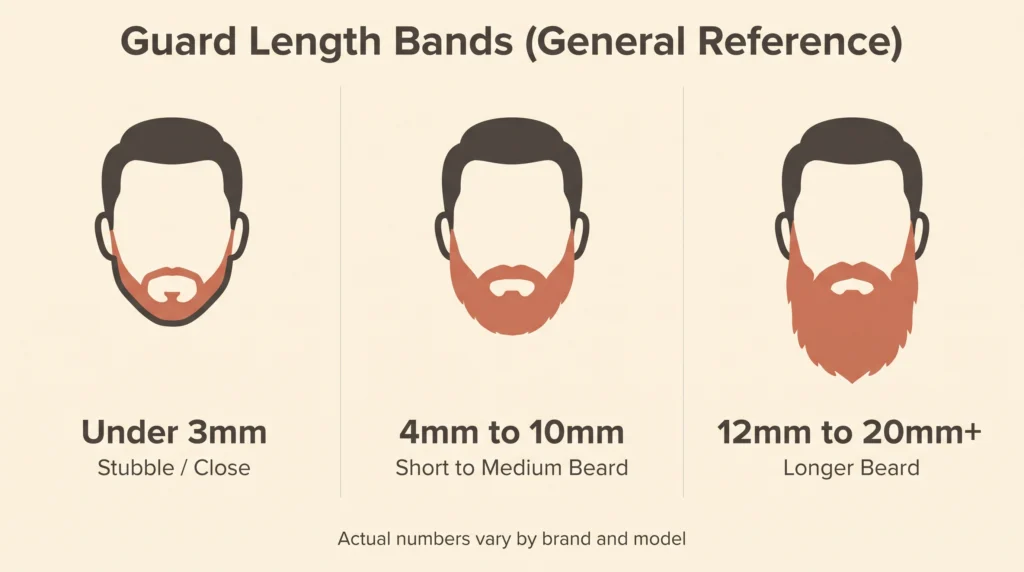
Guard numbers confuse a lot of first-time buyers because brands are not consistent about what a “3” or a “10” actually means in millimetres. As a general reference, most trimmers group guards into three rough bands: close, stubble-length settings sit under 3mm, short-to-medium beard settings run from about 4mm to 10mm, and longer beard settings go from roughly 12mm up to 20mm or more on trimmers built for longer growth. Always check the exact millimetre range printed on the box or listing rather than assuming every brand’s “level 3” means the same thing.
A general reference only, actual guard numbers vary by brand and model.
If you switch between a short, neat look and letting your beard grow out over a few months, a wider guard range saves you from buying a second trimmer later. If you keep a fairly consistent length, a narrower range built around that length usually feels more precise in daily use.
Trimmer, Razor or Clippers: These Are Not the Same Tool
It is worth being clear about what a beard trimmer is actually for, since the three tools get mixed up often.
A beard trimmer is built to cut hair to a controlled length using guard attachments. It shapes and maintains facial hair rather than removing it completely.
A razor or electric shaver is built to cut hair at or close to skin level, for a clean-shaven look or sharply defined edges. Trying to get a fully smooth shave from a beard trimmer usually leaves stubble behind and can irritate skin, since the guard is not designed to sit flush against it.
Hair clippers are built for the denser, faster-growing hair on your head. They can technically cut a beard in a pinch, but the blade spacing and guard sizes are usually coarser, so results on facial hair are less precise than a dedicated beard trimmer.
If your goal most mornings is a completely smooth, close shave rather than a shaped beard, an electric shaver is the better tool for the job. Our practical guide to choosing your first electric shaver and our comparison of foil vs rotary shavers both cover that decision in more depth. This guide focuses specifically on trimmers built to shape and maintain length, not remove hair completely.
Corded vs Cordless: Which Fits Your Routine
Nearly every trimmer sold today runs cordless, but a few corded or corded-capable models are still around, and the choice affects daily convenience more than most buyers expect.
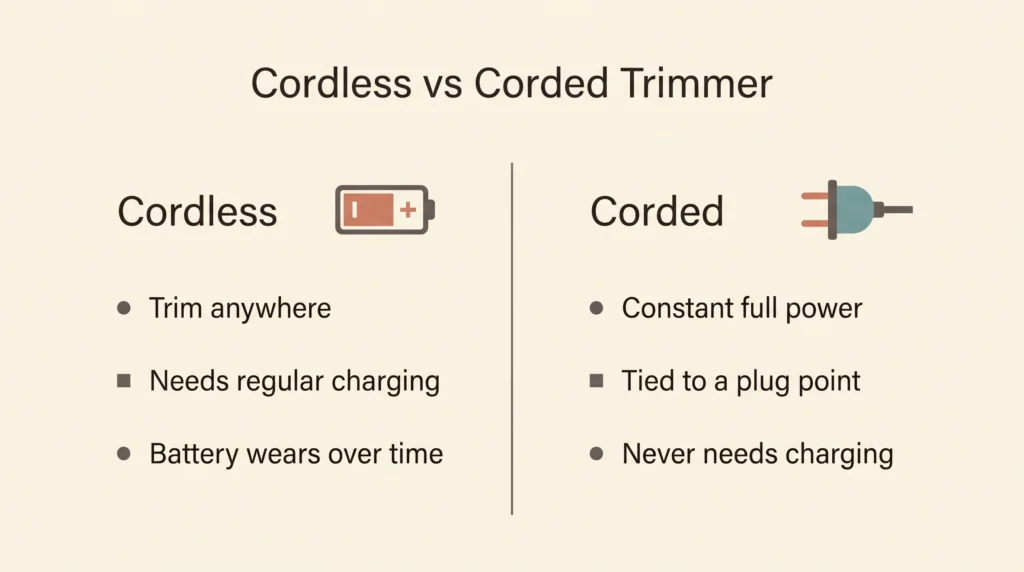
Best for: cordless suits anyone who wants to trim anywhere in the bathroom, including in front of a mirror away from a plug point, or in the shower. Corded suits someone who trims in one fixed spot and does not want to think about battery levels at all.
Consistency: a corded trimmer runs at full, constant power throughout. Cordless motors can lose a little power as the battery runs low, which occasionally shows up as slightly less clean cutting near the end of a charge on cheaper models.
Where each one falls short: cordless models need regular charging and eventually the battery itself wears down, the same way a phone battery does. Corded models tie you to a plug point and a cord, which is inconvenient in a bathroom without a nearby socket.
Cordless wins on convenience, corded wins on never worrying about charge.
Budget vs Premium: Where the Extra Money Actually Goes
A trimmer at the top of a listing is not automatically better for your beard. Here is what price generally does and does not buy once you are past the very cheapest bracket.
What improves with price: build quality and finish, longer runtime, more consistent motor power, better warranty and service network coverage, and self-sharpening or titanium-coated blades that stay sharp longer.
What usually does not improve much: the basic cutting experience for straightforward, short-to-medium beard maintenance. A mid-range trimmer with steel blades and a sensible guard range will cut just as cleanly as a premium one for most everyday trims.
Where budget trimmers genuinely fall short: weaker motors that struggle with thick or long growth, guards that do not lock securely and can slip mid-trim, and blades that are harder to source replacements for once they dull.
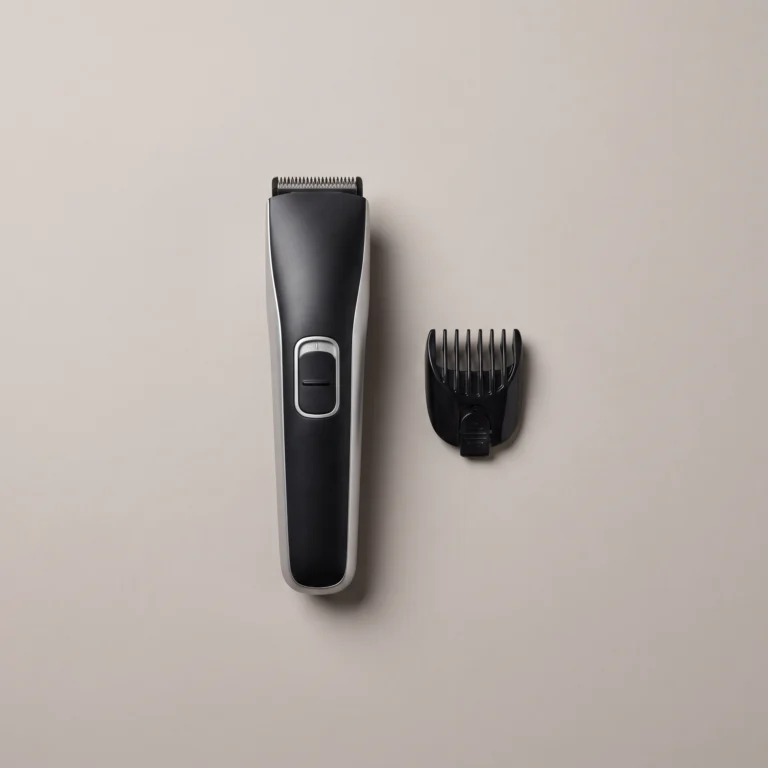
If your beard maintenance is fairly simple, mostly keeping a consistent short-to-medium length, a sensible mid-range trimmer with the five features covered above is usually enough. The following is the kind of trimmer worth considering as a starting point.
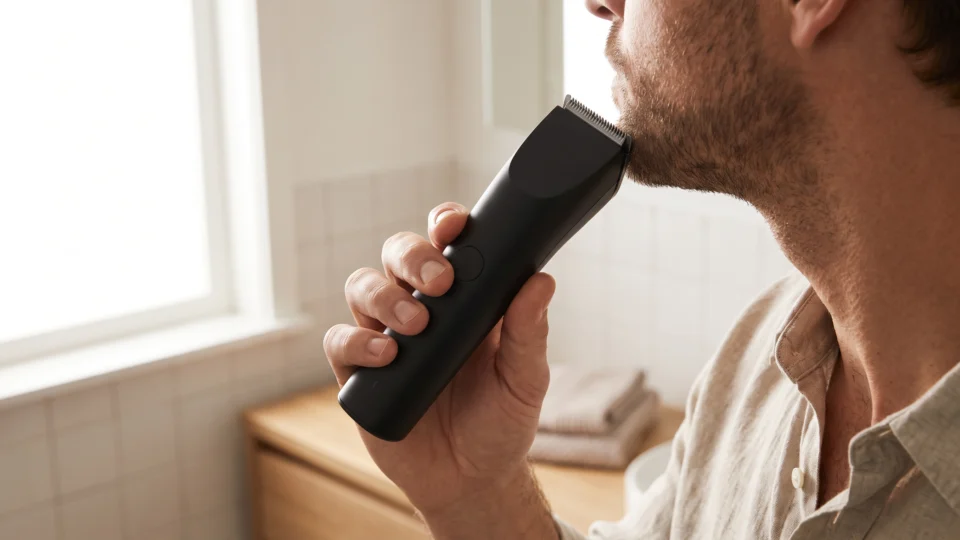
Representative editorial image, not official Amazon product photography.
Research-based evaluation
Cordless Beard Trimmer with Adjustable Guard
Why we picked it: This style of trimmer covers the five things that matter most for everyday beard maintenance, steel blades, a wide guard range, cordless convenience, and (on most models in this category) washable blade heads, without paying for features most buyers will not use.
Best for
Someone who wants one trimmer to handle everyday beard shaping, from close stubble to a longer maintained beard, without needing to buy a second machine as their beard grows out.
Strength
Wide guard range suits both stubble maintenance and a longer, growing beard
Watch out for
Cordless battery capacity varies a lot between specific models, check the stated runtime before buying rather than assuming
If you trim stubble every few days: prioritise a trimmer with precise low-end guard settings, under 3mm, and a motor that starts up fast, since you will be using it often and briefly.
If you are maintaining a longer, established beard: prioritise guard range at the higher end, 15mm and above, and a stronger motor that will not bog down in thicker growth.
If you travel often: cordless with a strong runtime and, ideally, dual-voltage charging matters more than any other feature on this list.
If you trim in the shower: confirm genuine wet-use, not just splash-resistance, before anything else on this list.
If this is your first trimmer and you are not sure yet: a mid-range model with a wide guard range gives you room to figure out your preferred length without committing to a narrow-range trimmer too early.
What a Beard Trimmer Will Not Do
Worth being upfront about the limits here. A trimmer will not give you a completely smooth, skin-level shave, that is a razor or electric shaver’s job. It will not fix an uneven beard growth pattern, though a good guard range makes an uneven pattern easier to work around. It will not last forever on the cheapest blades money can buy, expect to replace or sharpen blades eventually regardless of price. And no trimmer, however good, replaces a trim guide or mirror lighting if you are shaping a beard for the first time and are not confident with the lines yet.
You do not need the most expensive trimmer on the page, and you do not need every guard length ever made. You need steel blades, a guard range that actually covers where your beard sits today and where you want it to go, enough runtime to finish a trim without checking the battery, wet-use if that matters to your routine, and blades you can clean or replace. Everything past that is convenience and finish, worth paying for if your budget allows, but not the reason one trimmer cuts better than another.
Don't Miss the Next Guide
Get honest grooming guides, comparisons and buying advice from FIND N FORM, sent straight to your inbox.
This guide is a research-based evaluation using product specifications, brand information, publicly available user feedback and comparative analysis across current trimmer listings. It is not based on personal, hands-on testing of any single product.
Can a beard trimmer be used to cut hair on your head?
In a pinch, yes, but it is not ideal. Beard trimmers are built for the finer, slower-growing hair on your face, so most models will work slower and feel less smooth on denser head hair than a dedicated pair of hair clippers. If you cut your own hair regularly, a separate clipper is worth having.
Is a beard trimmer or a razor better for daily use?
It depends entirely on the look you want. A trimmer is better if you want to keep facial hair at a set length day to day. A razor or electric shaver is better if your daily routine is a clean, close shave. Many men use both, a trimmer for shaping and a razor for cleaning up the neckline and cheek lines.
How often should beard trimmer blades be replaced?
There is no fixed universal schedule, since it depends on how often you trim and how coarse your hair is, but noticeably pulling or snagging hair that did not happen when the trimmer was new is the clearest sign blades need cleaning, oiling or replacing. Rinsing or brushing out hair after every use and oiling the blades occasionally, if the manufacturer recommends it, extends blade life significantly either way.
Are cheaper beard trimmers actually worse?
Not always, but the risk is higher. A budget trimmer with steel blades and a sensible guard range can handle straightforward beard maintenance perfectly well. The extra cost of a premium model usually goes toward a stronger motor for thicker growth, longer battery life and better after-sales support rather than a sharper cut for everyday use, so cheaper is not automatically worse, it is just less forgiving if your beard is thick or you use it hard.
This article may contain Amazon affiliate links. As an Amazon Associate, FIND N FORM earns from qualifying purchases, at no extra cost to you. Our recommendations are never determined by commission.




Leave a Reply